
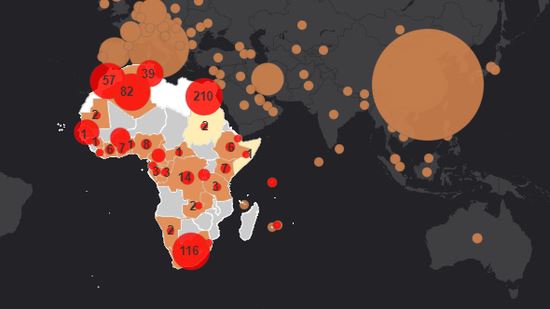
A picture of the map of Africa outlining some of the countries that have confirmed cases of Covid-19.(Photo/WHO)
Special: Battle Against Novel Coronavirus
More than 600 cases of COVID-19 have been confirmed in 34 countries in Africa as of 19 March, compared with 147 cases one week ago. Although the region has seen a significant increase in confirmed cases recently, there are still fewer cases than in other parts of the world.
"The rapid evolution of COVID-19 in Africa is deeply worrisome and a clear signal for action," said Dr Matshidiso Moeti, World Health Organization (WHO) Regional Director for Africa. "But we can still change the course of this pandemic. Governments must draw on all of their resources and capabilities and strengthen their response."
Twelve countries in the African region are now experiencing local transmission. It is crucial that governments prevent local transmission from evolving into a worst case scenario of widespread sustained community transmission. Such a scenario will present a major challenge to countries with weak health systems.
"Africa can learn from the experiences of other countries which have seen a sharp decline in COVID-19 cases through rapidly scaling up testing, isolating cases and meticulously tracking contacts," said Dr Moeti.
Understanding how the COVID-19 pandemic will evolve in Africa is still a work in progress. The response will need to be adapted to the African context – the demographics on the continent are very different from China, Europe and the USA.
WHO has been supporting governments with early detection by providing COVID-19 testing kits to countries in Africa, training lab technicians, and strengthening surveillance in communities. Forty-five countries in Africa can now test for COVID-19: at the start of the outbreak only two could do so. WHO is also providing remote support to affected countries on the use of electronic data tools, so national health authorities can better understand the outbreak in their countries. Personal protective equipment has been shipped to 24 countries, and a second shipment is being prepared for countries with confirmed cases.
"COVID-19 is one of the biggest health challenges Africa has faced in a generation," said Dr Moeti. "We can only stop this virus through solidarity. And the world is coming together. Donors are stepping up to the plate and providing funding while private sector in many countries are offering their support as well."
Lessons learnt in addressing previous epidemics are being used as a foundation to respond.
Basic preventative measures by individuals and communities remain the most powerful tool to prevent the spread of COVID-19. For this reason, WHO is helping local authorities craft radio messaging and TV spots to inform the public about the risks of COVID-19 and what measures should be taken. WHO is also conducting rumor management in all affected countries, and is guiding countries on setting up call-centers and hotlines to ensure the public is informed.
(Source: WHO)